How to be a Researcher: A Conversation with Emilia Mann (BRDD 2022)
Continuum: Life After the BRDD
This editorial is part of an ongoing alumni spotlight series celebrating the breadth and depth of the Brown|RISD Dual Degree community by following a thread of ideas, practices, and collaborations that trace how alumni across generations and geographies think and work at the intersections, carrying forward the program’s ethos of curiosity and multidisciplinarity long after graduation.
As a doctoral student in Mechanical Engineering at Rice University, Emilia Mann (BRDD 2022, Apparel Design; Engineering) investigates how textiles are assembled and disassembled. In conversation with two recent Dual Degree alumni, she reflects on her time at Brown and RISD and her work at Harvard's Biodesign Lab, tracing the evolution of her research – from an application-driven practice to one rooted in curiosity for its own sake. Along the way, she explores how to be a researcher, considering what it means to ask questions before seeking answers.
Emilia called in from Houston, TX, USA; Yukti V. Agarwal (BRDD 2024.5) from New Delhi, India; and Mehek Gopi Vohra (BRDD 2024) from Tahoe City, CA, USA.
This interview has been edited for length and clarity.
What took you from apparel to research?
I’ve always been interested in two main areas: sustainability in textiles, and assistive technology through wearables. During my time at RISD, I leaned more heavily into sustainability. For my senior capstone and thesis, I explored three parallel avenues of research: large-scale upcycling systems and what it would take to implement them; biomaterials, particularly mushroom-grown leathers; and strategies for addressing non-recyclable textile waste. After graduating I wanted to explore the wearable technology side more deeply and my RISD mentor, Catherine Andreozzi, connected me with the Harvard Biodesign Lab, which is where I spent the next three years.
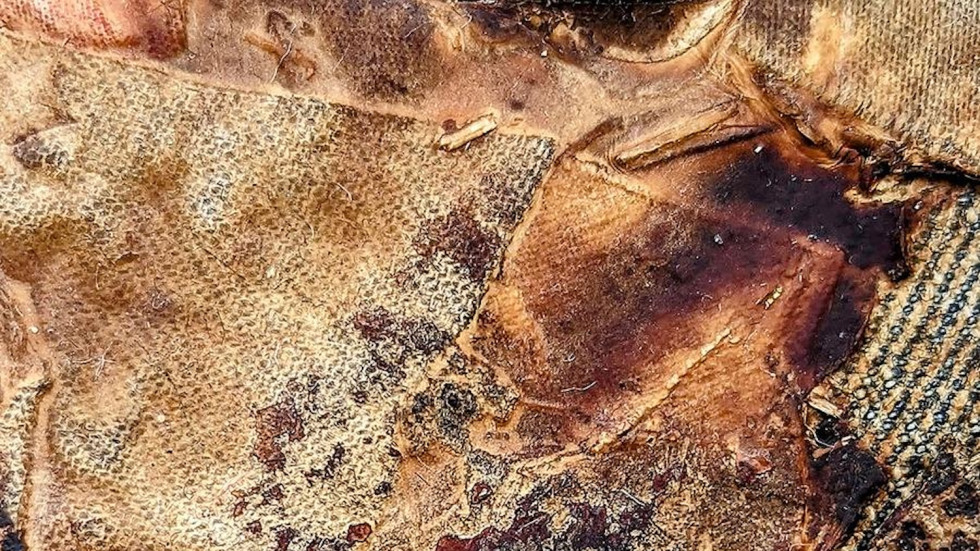
Detail of mycelium grown on fabric scraps. Grown for 4 weeks, pressed while drying, and autoclaved for 45 minutes and plasticized with glycerine.

Detail of mycelium grown on fabric headers. Grown for 1 week, pressed while drying, baked for 30 minutes at 200°F, and pressure cooked for 10 minutes and plasticized with glycerine.
What was research at Harvard Biodesign Lab like?
At the Lab I worked with Dr. Conor Walsh. We focused on wearable robotic exosuits for disabled and able-bodied people – primarily made from textiles. I worked on the upper-limb team, which focuses heavily on soft robotics using pneumatic systems – essentially inflatable structures – to assist individuals with stroke in lifting their arms. When I joined, the Lab had an early research-grade prototype: a shirt-like garment with an inflatable element under the arm. My role was taking this promising device and figuring out, beyond continuing to improve functionality, what changes would need to be made in order for the device to be independently used by stroke patients in their homes. For example, the garment relied on a zipper, which made it impossible for many individuals with stroke – who often are able to only use one hand – to put on independently.
For a time, I was the only apparel specialist in the lab and effectively led that area. I eventually built out a small team, hired new members (including some RISD alums!), and gained leadership experience I hadn’t expected so early in my career. This opened many doors. Through my work, I met Dr. Vanessa Sanchez, who has been affiliated with the Lab while also working in the Microrobotics Lab. We connected over our shared interest in textiles, and when she began her own lab it became clear it would be the ideal place to continue my research journey. I’m now a PhD student in her lab, texlab, at Rice University.
“ It’s strange, and that alone makes it worth investigating. ”
How has Rice University been so far? What are you up to there?
My work is still exploratory, which is expected at this stage. My research is focused on how textiles are structurally assembled and how they might be designed for efficient disassembly. We’re asking questions like: What prevents textiles from being disassembled at scale? How would they need to be designed differently from the start? Can valuable materials be reclaimed effectively?
There’s also a second, more exploratory lens: what new behaviors or functions emerge during disassembly? For example, I’m currently studying a knit structure that, when unraveled, spontaneously forms a tube and partially re-knits itself. I don’t know if it’s useful yet – but it’s strange, and that alone makes it worth investigating.
At the Harvard Biodesign Lab, I was joining an existing project and had a very specific role and goal I was full-filling. At texlab, I am building a research project from the ground up, which lends itself much more to exploration and investigation of fundamental principles. This shift has been challenging but exciting.
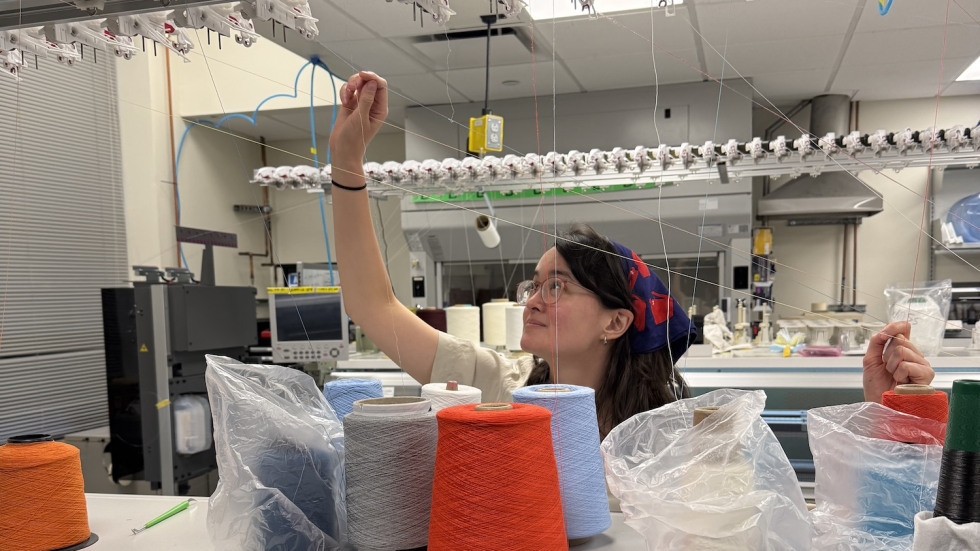
Emilia working in a lab at Rice University.
“ Humans make things for a reason, even if that reason isn’t immediately obvious. ”
How has this shift changed your definition of research?
Earlier in my education I tended to define research through application: sustainability, human-assisted wearables, or clear real-world use cases. More recently I’ve been learning what it means to be curious without immediately asking how something will be used. For me, research starts with an interesting or intriguing question and investigates it rigorously and systematically. That kind of “huh, that didn’t behave the way I thought it would” is a more fundamental research lens. It should be replicable and deepen understanding – not just produce results. RISD gave me a taste of that, where making and exploration don’t always have an immediate application, but they’re still meaningful. Humans make things for a reason, even if that reason isn’t immediately obvious.
How did your time at Brown and RISD prepare you for the work you’re doing now?
Someone told me that undergrad is “learning how to learn.” And [studying at both] Brown and RISD gives you a really good lens for how to learn in two different ways.
RISD trained me to work quickly, prototype rapidly, and solve problems that don’t yet have established solutions. We fabricated everything in-house, so I needed hands-on technical skills, which RISD had given me. Even the skills from Experimental and Foundation Studies – learning unfamiliar tools, experimenting without fear – proved invaluable. At Brown I understood mechanical testing, validation, and how to communicate with engineers in their language. That dual fluency meant that I wasn’t limited to fabrication; I could also support the labs’ research needs more broadly.